

The introduction of Biodiversity Net Gain (BNG) in February 2024 marked a major milestone in the UK’s approach to land management and sustainable development. Designed to ensure that new developments (such as housing) enhance the natural environment in a measurably better state than before, BNG represents a fundamental shift towards integrating nature recovery into land use decisions.
But one year on, how has BNG performed? Are farmers and land managers experiencing the anticipated benefits, or has the system introduced more hurdles than rewards? In this blog, we reflect on the progress made, the challenges encountered, and what lies ahead as BNG moves into its second year.
A Quick Recap on BNG

A key part of the UK’s 25-Year Environment Plan, Biodiversity Net Gain (BNG) requires all new developments to deliver a measurable 10% uplift in biodiversity—either through on-site improvement or through off-site habitat creation. The goal? To shift land-use planning from one of depletion to one of regeneration.
BNG can be delivered through actions such as:
- Creating new habitats: such as woodlands, wetlands, and wildflower meadows.
- Enhancing existing habitats: improving the condition of hedgerows, planting trees, and restoring degraded land.
- Trading biodiversity units: purchasing biodiversity units from landowners who deliver in habitat creation or restoration.
Key Insights and Challenges from BNG’s First Year

As BNG reaches its first year of implementation, it’s important to recognise that this is still early days for assessing its true impact. That said, early trends and reports have already provided some key insights, along with notable challenges:
- Increased awareness and engagement: Landowners, developers, and local authorities are more engaged in biodiversity discussion than ever before, reflecting a shift in land-use priorities.
- Growing number of partnerships: Greater collaboration between farmers, environmental organisations, and local government is helping to ensure that newly created habitats are managed effectively.
- Shift towards long-term Stewardship: There is a growing recognition of the importance of maintaining and monitoring habitats beyond the initial creation phase, leading to more strategic planning around long-term biodiversity management.
While these insights indicate positive momentum, BNG’s first year has also been marked with significant challenges for individuals responsible for land, including farmers, landowners and land managers:
- Complexity and regulatory uncertainty: Many landowners have found the process of quantifying biodiversity gains and navigating planning requirements to be more complicated than expected.
- Resource constraints: Local Planning Authorities (LPAs), who play a key role in approving Biodiversity Gain Plans, often lack the resources and expertise to assess applications consistently, leading to delays and uncertainty.
- Upfront investment costs: Creating and maintaining biodiversity-enhancing habitats often requires significant initial capital, with returns spread over decades—posing financial risks for smaller landowners.
- Market access barriers: While organisations such as land agents, wildlife trusts, consultants, and local planning authorities can assist farmers and landowners in finding interested buyers, the absence of a centralised trading platform for biodiversity units makes it increasingly difficult for landowners to connect with buyers.
Opportunities for BNG in 2025

As BNG enters its second year, there is a clear opportunity to refine the system to make it more accessible, effective, and financially viable. In line with the recently introduced Land Use Framework consultation, taking a systems approach to BNG could help to strengthen links between wider environmental policies, such as Environmental Land Management (ELMs) and Local Nature Recovery Strategies (LNRS).
Additionally, a more structured and centralised biodiversity credit trading system could help establish clearer pricing, better transparency, and a more streamlined transaction process. Regulatory refinements are also needed to simplify biodiversity assessments, improve compliance monitoring, and ensure LPAs have the resources to process applications efficiently. With the right adjustments, 2025 could mark a critical turning point in making BNG a truly effective tool for both biodiversity recovery and sustainable land management.
Navigating BNG with Land App’s Tools
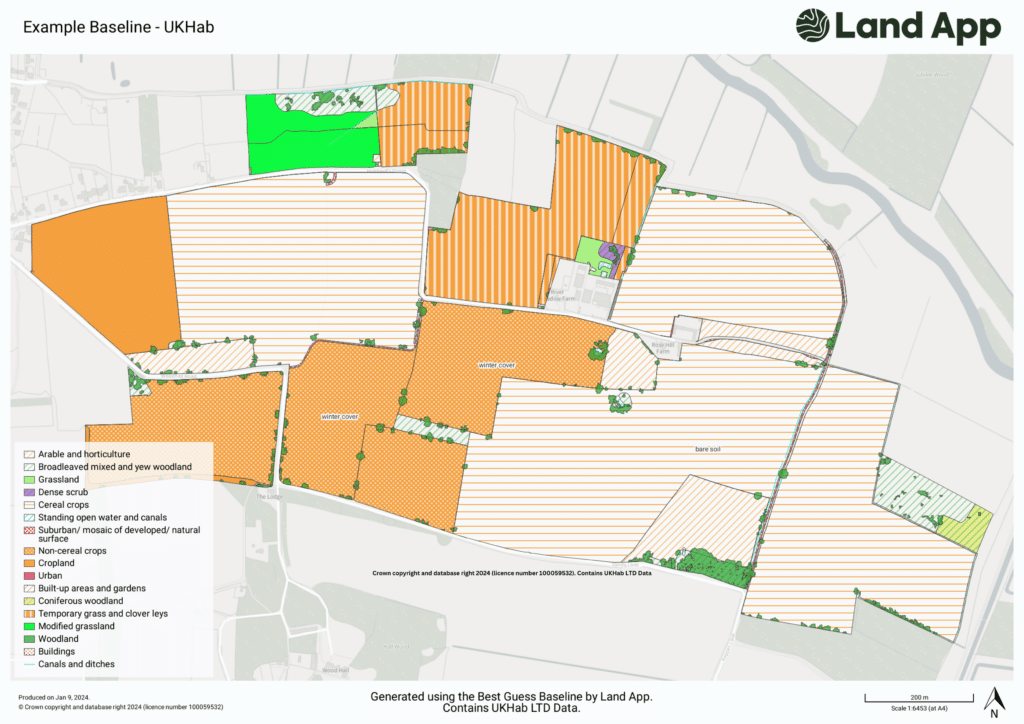
For these opportunities to become a reality, there is a need for powerful tools that make planning, assessing, and designing BNG projects seamless and intuitive. By leveraging cutting-edge environmental and spatial data, our suite of tools offers a fast and efficient way to calculate biodiversity units and plan habitat enhancements.
Our platform allows users to:
- Instantly estimate biodiversity units with our BNG Estimator Tool, providing clear breakdowns and easy comparisons to make informed land management decisions.
- Easily assess and integrate habitat data, either using detailed Baseline Habitat Assessments or quick biodiversity estimates with the UK Habitat Best Guess Baseline.
- Plan and enhance biodiversity uplift by exploring different scenarios for habitat creation and enhancement, unit potential can be appraised and compared; helping maximise both environmental and financial benefits.
- Stay up to date with the latest UKHab data, our partnership with UK Habitat ensures reliable habitat classifications, real-world insights, and ongoing updates tailored to evolving standards.
- Unlock financial opportunities by visualising the impact of biodiversity on land value, calculating potential returns from biodiversity credits, and streamlining workflows to save time and effort.
- Streamline collaboration on BNG projects with our cloud-based mapping system. Easily share plans with stakeholders, invite collaborators to specific maps, and see real-time updates as team members assess, adjust, and refine biodiversity strategies.
Looking Ahead
One year on, it’s clear that Biodiversity Net Gain (BNG) has sparked positive change, with more farmers, landowners, developers, and policymakers recognising the value of integrating nature into land-use planning. However, its full potential remains untapped. As we move through 2025 and into the coming years, there’s a real opportunity to streamline processes, strengthen collaboration, and establish a more structured biodiversity credit system. And Land App is here to make that vision a reality by offering an all-in-one platform that streamlines planning, appraisal, and design, making BNG projects more accessible and impactful than ever.
For more information on how Land App fits into BNG, read our blog post and visit our dedicated funding page.
